

 Praveen Kumar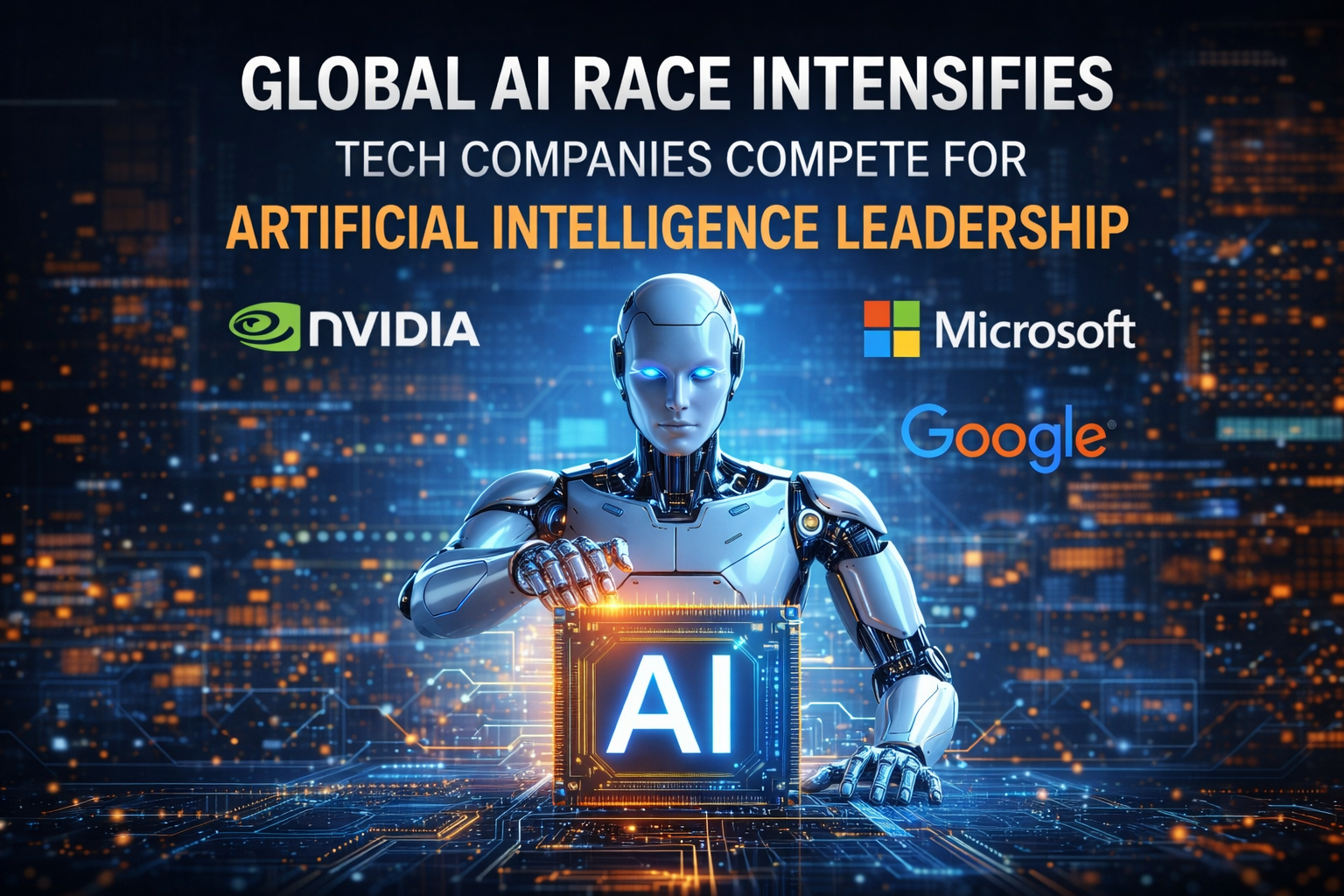
The Global AI Race for artificial intelligence is intensifying as major technology companies invest billions of dollars in advanced AI development. With rapid progress in machine learning, cloud computing, and data processing, tech giants are competing to lead the next generation of intelligent systems that could reshape industries and economies worldwide.
The Rise of AI Technology
Artificial intelligence has moved from research labs into everyday life. From chatbots and voice assistants to advanced data analysis tools, AI technology is now used in many industries including healthcare, finance, education, and transportation.
Major tech companies like Microsoft, Google, and OpenAI are investing heavily in artificial intelligence development. Their goal is to create smarter systems that can automate tasks, improve productivity, and transform how businesses operate.
This rapid growth has created a huge demand for powerful computer chips capable of handling complex AI calculations.
Nvidia’s Role in the AI Revolution
At the center of this demand is Nvidia. Originally known for designing graphics cards for gaming, the company has successfully positioned itself as a global leader in AI hardware.
Nvidia’s advanced GPUs (graphics processing units) are now widely used to train large artificial intelligence models. These chips can process massive amounts of data simultaneously, making them essential for building modern AI systems.
According to industry experts, most major AI platforms currently rely on Nvidia hardware to power their computing infrastructure.
The company’s CEO, Jensen Huang, has repeatedly emphasized that AI will become one of the most important technological developments of the 21st century.
Global Tech Companies Join the Race
As artificial intelligence continues to grow, technology companies are competing to develop faster and more efficient AI tools.
Companies like Microsoft and Google are integrating AI into their cloud services, search engines, and productivity tools. Meanwhile, startups and research organizations are developing innovative AI solutions for industries ranging from medicine to cybersecurity.
This competition has created what many experts now call the global AI race, where companies and countries are trying to secure technological leadership.
Economic Impact of AI Growth
The rapid development of artificial intelligence is not only transforming technology but also affecting the global economy.
According to market analysts, the AI industry could add trillions of dollars to the global economy in the coming decades. Businesses are increasingly using AI tools to analyze data, automate operations, and improve decision-making.
However, the rise of global AI race also raises concerns about job displacement and ethical issues. Some experts worry that automation may replace certain types of jobs in the future.
Because of this, governments and policymakers around the world are discussing how to regulate artificial intelligence while still encouraging innovation.
Opportunities for Startup and Developers
Despite concerns, the global AI race boom is creating massive opportunities for developers, entrepreneurs, and technology startups.
Many small companies are now building AI-powered tools that help businesses improve efficiency. From marketing automation platforms to smart healthcare systems, AI applications are rapidly expanding across industries.
Investors are also pouring funding into AI startups, hoping to support the next big breakthrough in technology.
Experts say the global AI race industry is still in its early stages, meaning innovation and new opportunities will continue to emerge in the coming years.
The Future of Artificial Intelligence
Looking ahead, artificial intelligence is expected to play an even bigger role in shaping the global economy. Technologies such as autonomous vehicles, smart robotics, and advanced medical diagnostics are likely to rely heavily on AI systems.
Companies like Nvidia, Microsoft, and Google will continue to invest in developing faster computing systems capable of handling increasingly complex AI models.
At the same time, governments and international organizations are expected to introduce policies aimed at ensuring that AI technologies are used responsibly and ethically.
Conclusion
The rapid growth of artificial intelligence is transforming the global technology landscape. As companies compete to build smarter and more powerful AI systems, demand for advanced computing hardware continues to grow.
With its cutting-edge AI chips, Nvidia has positioned itself at the center of this technological revolution. The company’s innovations are helping power the next generation of artificial intelligence tools that may reshape industries and economies around the world.
As the global AI race continues, one thing is clear — artificial intelligence will remain one of the most important technological forces shaping the future.
You can also read: Micron Chip Plant: A Major boost for India’s Semiconductor future.